 Horse Country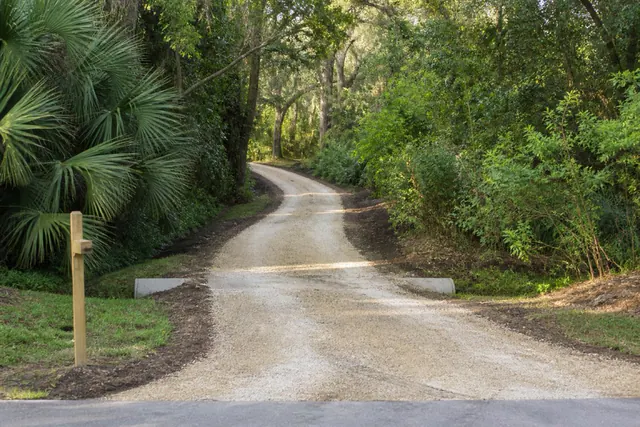
Horse Country Clearing puts Davie property owners in touch with a local land clearing contractor who handles access road & driveway clearing on Davie and Broward County ground.
Plenty of Davie parcels are easy to buy and hard to reach — flag lots behind other homes, back acreage separated from the road by a swale and a wall of growth, barns placed long before anyone thought about a hay truck's turning radius. Access clearing solves the geometry: a corridor cut through the vegetation, then built into a drive that works in July, not just March.
The cut is the fast part. A mulcher opens the alignment — typically twelve to sixteen feet wide for a single-lane drive with clearance for mirrors and trailer fenders — and overhead limbs come up to legal-load height. The build is what separates a driveway from a rut: organics stripped from the running surface, geotextile where the subgrade is soft, then compacted shellrock built with a crown that throws rain off the shoulders rather than letting the wheel paths pond.
Every Davie access job crosses water sooner or later, because the town's grid of swales and canals is how flat land drains. Crossings get sized culverts set at the right invert, not a load of fill shoved into the ditch — the difference between a drive that lasts and a code violation that floods your neighbor. Done right, the same corridor also becomes the utility route: power, water, and fiber trench once, in one line.
Building for the water table, wheel loads, and horses
A Davie drive carries odd traffic: horse trailers, hay deliveries, farriers' rigs, the occasional concrete truck. Base depth follows the heaviest regular load, and on ground the USDA maps as sand shallow over limestone — see the Hallandale series description — the rock floor is often an asset, giving compacted shellrock a firm bottom to lock against. Wet corners that never firm up get over-excavated and bridged with fabric and stone rather than wished away.
Where a drive parallels a paddock, the finished shoulder matters: no berms that trap water against the fence, and sight lines kept open where riders cross. Small details, but they're the ones a horse-country operator builds in by default.
Swale crossings and the rules of the ditch
The grassy ditch between your land and the pavement is a working drainage structure connected, eventually, to the regional flood network in the South Florida Water Management District's care. Driveway crossings over it are a permitted improvement in most of the county, with pipe size and placement subject to town approval — the Town of Davie handles its own right-of-way rules. A contractor who builds these regularly folds the approval into the schedule instead of treating it as a surprise.
Skimping on pipe diameter always collects its debt: the crossing behaves until a real storm piles water against the upstream side, then the crossing overtops and the shellrock leaves. Size for the storm, set the invert to the ditch flow line, and armor the ends — then forget about it for twenty years.
Further reading
Worth knowing first
What does a new shellrock drive cost per foot?
It moves with corridor condition and base depth — clearing a growth tunnel costs more than grading open ground, and a trailer-rated base costs more than a golf-cart path. Crossings are priced as their own item. The quote breaks all three apart so you can phase if needed.
How wide should an equestrian-property drive be?
Twelve feet of running surface handles most trucks; fourteen to sixteen is kinder to trailer mirrors and lets the corridor breathe. Gates and turns are the real constraint — swing radius for a gooseneck gets planned before the first tree is cut.
Shellrock, asphalt millings, or concrete?
Shellrock is the local default: cheapest, repairable by the load, and honest-looking in ranch country. Millings pack harder and dust less but run hotter underfoot. Concrete belongs at aprons and barn approaches. Many owners run shellrock first and upgrade the high-wear sections later.
Will the drive survive the summer rains?
That's a construction question, not a materials question. Crowned surface, functioning side drainage, and a properly set culvert survive; flat-bladed rock dumped on organics does not. Insist on the boring details — they're the product.
Can you keep the corridor looking like a country lane rather than a cut?
Yes — selective clearing that snakes the alignment between keeper oaks and palms costs a little more layout time and pays it back forever. Straight-line clearing is for utility easements, not entrances.