 Horse Country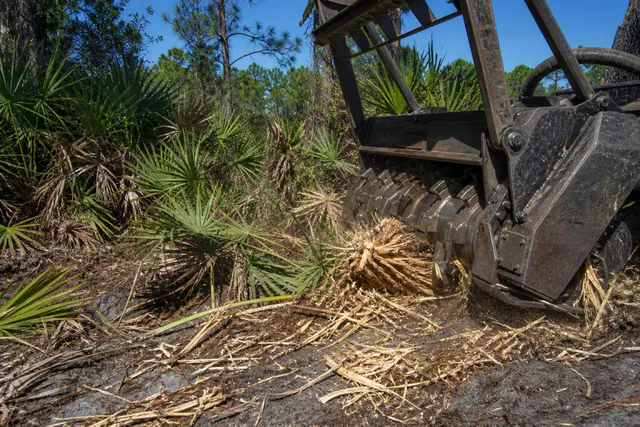
Horse Country Clearing puts Davie property owners in touch with a local land clearing contractor who handles palmetto removal on Davie and Broward County ground.
Saw palmetto is native, tough, and magnificently stubborn. It spreads on horizontal trunks that creep along and under the ground, each crown sending up fans of serrated blades that will still be there when the paint on your house has failed twice. A stand that has owned a lot corner for decades is effectively a woody mat a foot thick — no string trimmer, tractor bucket, or weekend of machete work makes a dent worth the blisters.
Real removal is a two-layer job. The mulcher takes the fans and exposed trunks down to grade first. Then comes the decision that separates a tidy lot from a regrowing one: palmetto crowns left in the ground push new fans within months, so ground that needs to stay clear gets the crowns and runners grubbed out with an excavator or root rake, shaken free of sand, and staged for hauling or burial on site where that's appropriate.
Worth saying plainly: palmetto isn't an enemy. It's valuable wildlife cover and it holds sandy ground against erosion, which is why plenty of Davie owners clear the acre's center and deliberately keep a palmetto edge along the back line. Clearing the part you need and keeping the part that works is a conversation the quote walk-through is made for.
Why palmetto beats casual clearing attempts
The plant's energy lives in that creeping trunk, not the fans, so cutting fans is cosmetic — the crown simply refunds them. Palmetto also thrives on exactly the ground much of Davie sits on: the USDA's Hallandale fine sand series description records limestone bedrock as shallow as 7 inches, and palmetto runners ride along that rock layer where deep tillage can't follow. Getting crowns out of shallow-rock sand without gouging the limestone is machine work with a light touch.
There's a fire angle too. Dry-season palmetto is resinous and burns hot — it's a classic wildland fuel, and the Florida Forest Service tracks wildfire conditions statewide. Thinning a palmetto mass away from barns, fences, and propane tanks is cheap insurance on the rural west side of town.
What happens to the ground afterward
Grubbing palmetto leaves disturbed sand studded with root fragments, so a finished job includes raking, a compaction pass where the area will be driven or mowed, and either seed, sod, or mulch cover so summer rain doesn't cut channels through bare ground. On pasture conversions, owners typically follow with bahiagrass seed in the growing season.
Expect stragglers. Even careful grubbing misses the odd runner, and native seed is always in the soil, so a light follow-up pass a year later is normal — mentioned here because a contractor who quotes Broward palmetto honestly will tell you the same thing. Wildlife agencies' guidance on Florida's nonnative species is also a useful reference for deciding what should replace the cleared scrub.
Further reading
Worth knowing first
Why is palmetto removal priced higher than regular brush?
Because it's two jobs: grinding the visible plant, then digging the crown-and-runner mat out of the sand. The below-ground half is slower, harder on equipment, and produces heavy spoil — that's what the price reflects.
Can palmetto be permanently removed?
Ground that gets crowns and runners grubbed out stays essentially clear, with only minor seedling touch-up afterward. Mulching-only removal is temporary by nature — the crowns refund fans within a year.
Am I allowed to take saw palmetto off my own lot?
Clearing palmetto on your own residential lot is routine. Rules aim mostly at commercial berry harvesting and protected natural areas — and any parcel with gopher tortoise burrows in the scrub needs those checked before machines work, which the contractor will flag on the walk.
How long does clearing a palmetto patch take?
A typical house-lot patch — say a quarter acre of established fans — is usually a one-to-two-day job including grubbing and cleanup. Big multi-decade stands on acreage scale up from there.
Should I keep any of it?
Often yes. A palmetto band along a rear fence is free privacy, bird and pollinator habitat, and erosion control. Many Davie jobs are partial clears for exactly that reason.