 Horse Country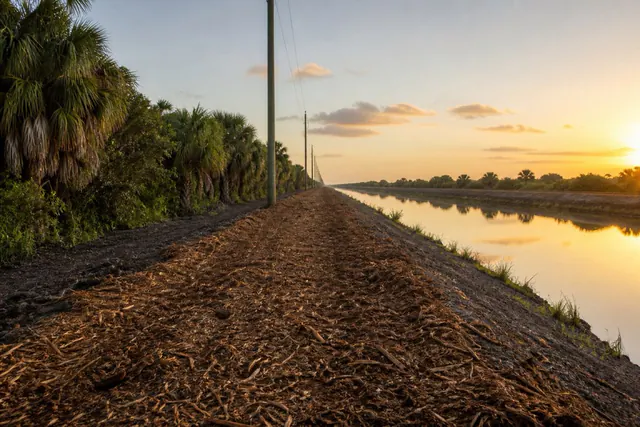
Horse Country Clearing puts Davie property owners in touch with a local land clearing contractor who handles right-of-way clearing on Davie and Broward County ground.
Corridor work marries clearing machinery to a written spec and a deadline. Utility easements, canal maintenance berms, pipeline corridors, and access tracks all have to stay open — inspectable on foot, passable for a bucket truck, clear of the growth that turns into outage risk or blocked drainage. The production tool is the same forestry mulcher used on residential ground, run in long straight passes at corridor scale.
Broward's corridors have a distinctive enemy list. Brazilian pepper colonizes every unmowed canal bank; melaleuca and earleaf acacia recruit along the wetter western easements; and guinea grass fills whatever's left. The practical spec most clients want is vegetation held below a set height across a set width, with woody stems ground rather than cut — mulched stubble regrows slower and stays passable, where cut stumps make a corridor of spikes.
The commercial disciplines are what clients are really buying: crews that show up when the schedule says, work documented by station or GPS track, machines that don't leak what they shouldn't onto a drainage bank, and flagging or spotters where corridors cross roads, trails, and driveways. Volume pricing follows naturally — corridor miles quote far below the same acreage scattered across residential jobs.
Working beside the water
Much of the right-of-way inventory in this county exists because of drainage: maintenance berms and access tracks that follow the canals moving stormwater out of the neighborhoods, part of the larger system operated by the South Florida Water Management District together with the local drainage districts. Clearing on these banks answers to water-quality practice — mulch directed away from the channel, no equipment fluids near the water line, bank soil left armored by grass roots rather than scraped raw.
Species knowledge earns its keep here too: a pepper dome leaning over a canal is removed so its root ball doesn't rip the bank when it eventually falls, which is a different operation than mowing the same species on flat ground. Regional invasive coordination through bodies like the Florida Invasive Species Partnership shapes what corridor managers ask for.
Cycle scheduling: the economics of staying ahead
Corridor vegetation management is cheapest as a rhythm and most expensive as a rescue. A mulched Broward corridor on a two-to-three-year return cycle stays light regrowth forever; skip two cycles and the pepper is trunk-diameter, the machine hours triple, and the line crews are working around genuine trees. Fire load is part of the same calculus on the drier western tracks — the Florida Forest Service monitors wildland fire conditions statewide, and a maintained corridor doubles as a fuel break.
For property managers and HOAs holding smaller easements, the same logic scales down: put the perimeter on a cycle, pay the small number annually, and never meet the big one.
Further reading
Worth knowing first
Who actually owns the corridor being cleared?
Usually the underlying landowner, subject to an easement holder's rights — which is why scope, boundaries, and notice are pinned down in writing before machines mobilize. Crews working Broward corridors are used to operating across dozens of adjacent ownerships in a single run.
Can right-of-way mulching run during the wet season?
Tracked machines keep working through most of it — the constraints are soft bank soils and lightning windows, both managed by scheduling segments flexibly. Annual programs typically front-load the wettest reaches into the dry months.
What width and height spec is typical?
Whatever the easement instrument or utility standard requires — common asks run 15 to 30 feet of width held to low stubble, with side-trimming to a vertical clearance over access tracks. The spec is written into the contract so 'done' is measurable.
How is corridor work priced?
By the acre or the corridor mile at an agreed spec, with density classes set after a drive-through or aerial look. Cycle contracts price lower than one-off rescues for the obvious reason: lighter regrowth, predictable production.
Do you coordinate with the utility or district?
The hiring party holds the relationship, but crews here are used to district notice requirements, locate tickets, and working under energized lines with the appropriate clearances — that coordination is part of the job, not an extra.