 Horse Country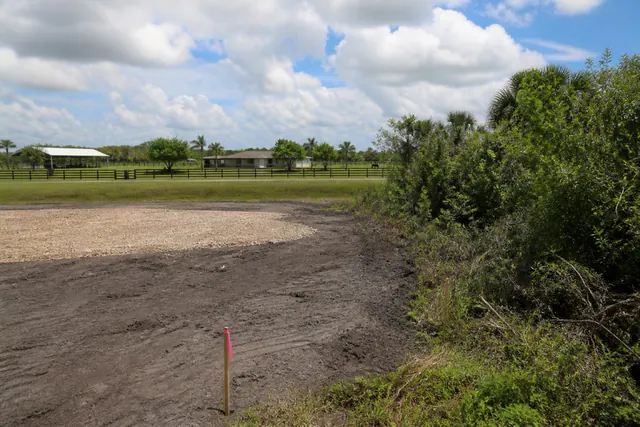
Horse Country Clearing puts Davie property owners in touch with a local land clearing contractor who handles lot clearing on Davie and Broward County ground.
Lot clearing is where a Davie parcel stops being scenery and starts being a project. It's the full conversion: exotics and unwanted growth taken out, keeper trees protected, stumps and root mats grubbed, debris ground or hauled, and the surface left at a rough grade a builder can actually work from. On an acre ranchette, the before and after are two different properties.
The sequencing matters more here than on any maintenance job. Survey and utility locates come first — flags before machines, always. Then protected and keeper trees get barricaded at the drip line, because an inch of fill or a track across root plates can quietly kill an oak the plans were drawn around. Only then do the extraction and grinding start, working from the access point outward so material moves once instead of three times.
Davie adds its own wrinkles: limestone close beneath the sand that dictates how deep grubbing can economically go, a wet-season water table that decides when heavy trucks can cross the ground, and the neighborly reality that machines are often working a fence line away from horses. A contractor who clears lots in this town plans all three into the schedule, not around them.
Trees: what comes out, what must stay
Clearing a lot is not carte blanche on trees. Davie and Broward County regulate removal of protected species — a mature live oak generally needs municipal sign-off before it comes down, while invasive exotics like pepper and melaleuca are the opposite case, often required to go. The Town of Davie and Broward County's environmental resources office publish the rules; the practical move is to have the clearing contractor and your builder align the tree plan before permits are filed, so the site work never has to stop and wait.
Keeper trees earn their place. A homesite that saves its best oaks and cabbage palms starts life shaded, anchored, and worth more — and clearing selectively around them costs far less than replacing mature canopy ever could.
What 'ready to build' means on this soil
Much of central Broward sits on sandy soils shallow to rock — the USDA's Hallandale series description puts limestone as little as 7 inches down in places. That's good news for bearing capacity and bad news for anyone hoping to bury big stumps deep: grubbing spoil on these lots is usually hauled or ground rather than trenched in. A cleared Davie pad typically finishes with structural fill — the local tan shellrock — compacted where the slab and drive will land.
Drainage is the other half of readiness. Flat ground and a high water table mean the finished rough grade must shed water toward the swale, not the future house. It's cheaper to shape that with the clearing machine already on site than to re-mobilize a dozer after the first flooded summer proves the point.
Further reading
Worth knowing first
What does it cost to clear a one-acre lot in Davie?
Full clear-and-grub with hauling lands well above mulching-only work — nationally the average runs around $3,000 an acre and dense South Florida growth pushes complex jobs higher, while a lightly wooded acre can come in under that. Access, stump count, and disposal distance move the number, so the walk-through quote is the real answer.
How long does a residential lot clear take?
Figure roughly a working week on a badly overgrown acre — take-downs and grinding up front, then grubbing, then hauling and rough grade to finish. Weather and hauling logistics are the usual variables.
Do I need permits before clearing?
For a buildable-lot conversion, usually yes — tree removal and land development rules apply in Davie, and the paperwork should precede the machines. The contractor quoting the job will tell you exactly which approvals your parcel needs; exotics-only vegetation work is often far simpler.
Can you clear just part of my lot?
Absolutely — partial clears are the Davie norm: open the homesite and driveway corridor, keep the back acre in shade trees and palmetto edge. Phasing also spreads the cost.
What happens to all the debris?
Most vegetation gets ground on site into mulch that either stays (free ground cover) or leaves in trucks; stumps and root balls are hauled to green-waste processing. Burning is not part of residential lot work here.