 Horse Country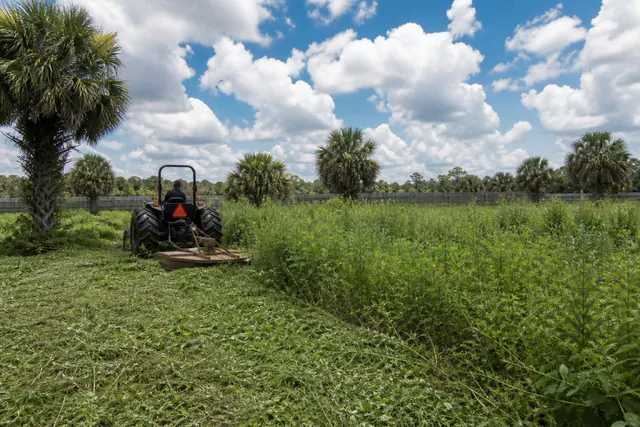
Horse Country Clearing puts Davie property owners in touch with a local land clearing contractor who handles brush & underbrush clearing on Davie and Broward County ground.
Give a Davie back acre eighteen unattended months and it writes its own jungle: dog fennel over your head, ragweed and caesarweed filling the gaps, grape and air-potato vine stitching it all together. Brush clearing is the reset — a rotary cutter or light mulcher pass that takes the tangle down to ankle height and gives you back a parcel you can actually walk, fence, or mow.
The job sits a size below full forestry mulching. Nothing here has real trunk diameter; the challenge is density, hidden obstacles, and the things soft growth conceals — old wire, dumped concrete, fire-ant mounds, a forgotten culvert. An operator who has cleared central Broward lots works the first pass high on purpose, watching what the deck kicks up before dropping to a finished height.
Regularity is the cheat code. A parcel brushed once a year stays a light, quick, inexpensive cut. Skip three years and the fennel lignifies, the pepper seedlings recruit into saplings, and the same acre graduates into mulcher territory at mulcher prices. Owners who hold land for future building often put the annual cut on the calendar for exactly this reason.
Why untended Broward ground goes feral so fast
Two engines drive the overgrowth: a twelve-month growing season and a seed bank full of exotics. The state's invasive-plant problem is big enough that the Florida Fish and Wildlife Conservation Commission runs dedicated invasive-plant management programs, and groups tracked through the Florida Invasive Species Partnership coordinate regional control work. On a private acre, the same species those agencies fight — pepper, air potato, shrub verbena — are what fills your brush line.
Cutting before seed set matters more than most owners realize. A fennel stand mowed in early summer is a mowing job; the same stand gone to seed in late fall reloads the soil for years. The operator's calendar advice is free — take it.
Wet-season mowing without wrecking the ground
Flat parcels near canals hold water from June through October, and a heavy machine in the wrong week leaves ruts that outlast the brush. Local crews watch the radar out of the Miami NWS office, run tracked equipment with low ground pressure, and stage from the high side of the lot. If a corner is standing in water, the honest answer is to cut around it and return — and a good quote says so up front.
The finished cut also changes how the land drains. Removing a thicket wall lets sheet flow reach the swale it was always meant to find, which is why crews here leave grassy swale lines intact and never blade them flat during a simple brush job.
Further reading
Worth knowing first
How is brush clearing priced — by the acre or by the hour?
Small residential parcels are usually flat-bid after a look; larger tracts go by the acre with density setting the rate. Light annual regrowth costs a fraction of a first-time cut on years of tangle, which is the argument for keeping a schedule.
Will the cut material be hauled away?
For rotary-cut brush the clippings are usually left to break down — they disappear into the ground in weeks during the wet season. Windrowing or hauling can be added when the parcel is being staged for sale or construction.
Can you clear brush without harming the trees I want to keep?
Yes — keeper oaks, palms, and citrus get flagged on the walkthrough and the cutter works around a clean drip-line radius. Marking day is also the time to point out irrigation heads and shallow lines.
What about snakes, fire ants, and rats in the overgrowth?
Dense brush is exactly where they live, which is a fair reason to stop letting it stand. The mowing pass itself displaces most wildlife ahead of the deck; what you're left with is short cover that no longer hides mounds, burrows, or dump piles.
How often should an idle Davie lot be cut?
Once a year keeps most parcels in the cheap-and-easy category; twice a year keeps a lot looking kept. Past two skipped years, expect sapling regrowth and a bigger machine on the next visit.