 Horse Country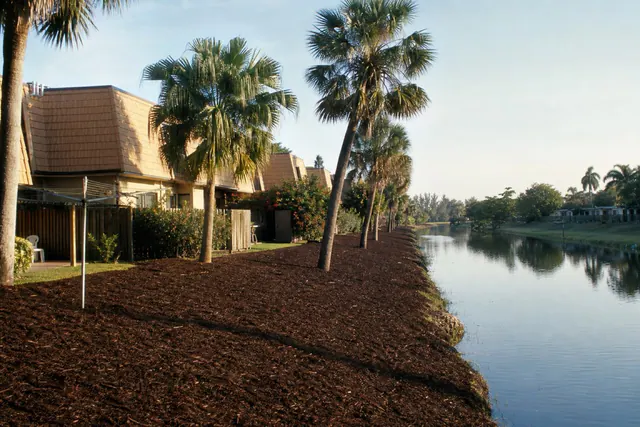
Horse Country Clearing puts North Lauderdale property owners in touch with a local land clearing contractor who takes on mulching, clearing, and exotic removal across the North Lauderdale area.
North Lauderdale — 44,794 residents at the 2020 Census — was built in a hurry in the 1970s as a planned community, and a half-century later its shared edges are where the vegetation debt collects. Townhome rows backing canals, HOA berms and perimeter walls, retention lakes ringed by maintenance strips: the city's clearing work is mostly linear, mostly shared, and mostly overdue by the time anyone calls.
The signature project is the association rear line: a few hundred feet of canal bank behind a row of units, grown into a continuous pepper-and-ficus wall that has eaten the water view and started leaning on privacy fences. One mobilization clears the whole run — machine work along the corridor, hand work at the patio fences — and the per-unit cost lands at a fraction of what owner-by-owner clearing would total.
Retention lakes and drainage tracts follow the same rhythm at HOA scale. These features have to move water when the summer ridge parks a storm over the county, and growth on their banks isn't landscaping — it's deferred infrastructure maintenance. Boards that put the corridors on a return cycle stop buying rescues and start buying upkeep.
How association clearing actually gets scoped
HOA jobs live or die on scope clarity, so the process is documentary from the start: the corridor walked and measured, the spec written as a maintainable condition (height, width, finish) rather than adjectives, unit-priced bids the board can compare, and completion photos stationed along the run. Where corridors touch district-maintained drainage, coordination follows the frameworks the South Florida Water Management District operates within.
Resident communication is half the job: notices before machine days, patios flagged where hand crews will work, and gates never left open on a community with pets. Boring professionalism, repeated for a few hundred feet at a time.
The pepper wall as a shared-cost problem
Brazilian pepper's biology — bird-planted, fast, indifferent to fences — makes it a collective-action problem wherever homes share edges, and UF/IFAS's control publication is blunt about the follow-up any lasting removal needs. For associations the translation is simple: clear the corridor once, then write the annual seedling pass into the landscape contract so the wall never rebuilds. General exotic-species context lives at the FWC's nonnatives pages.
Individual townhome owners aren't left out: single rear-line jobs are done regularly where an association won't move, sized to one unit's frontage and priced accordingly. The economics just improve every time a neighbor joins.
Further reading
Worth knowing first
Can one quote cover our whole association's perimeter?
Yes — corridor work is measured, specced, and unit-priced for exactly that, with the board getting a single document covering the full run and any phasing options.
What does canal-bank clearing behind townhomes cost per unit?
Grouped, it typically drops to a small fraction of a standalone job — one mobilization spread across the row. The spread depends on growth density and how the debris has to move out.
Our retention lake bank is overgrown — is that your work or the lake company's?
The woody upland growth is machine clearing — this work. In-water aquatic spraying is the lake-management contractor's lane. The two coordinate on plenty of North Lauderdale ponds; the quote marks the handoff line.
How disruptive is corridor clearing for residents?
A day or a few of machine noise during working hours, patios flagged in advance, and access maintained throughout. The corridor is passable each evening — no half-cleared hazards left standing.
How often should a cleared corridor be re-serviced?
An annual light pass holds it indefinitely. Without one, plan on machine-scale regrowth in roughly four to six years — the pepper cycle is dependable that way.