 Horse Country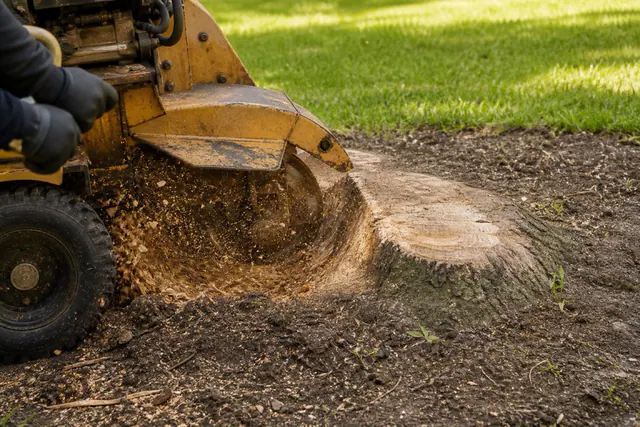
Horse Country Clearing puts Davie property owners in touch with a local land clearing contractor who handles stump grinding on Davie and Broward County ground.
Take a tree down and the ground keeps a question for you. A stump left proud is a mower obstacle, a termite buffet, and — in the case of ficus and Brazilian pepper — a living root system planning its comeback. Grinding retires it: a carbide wheel sweeps the stump repeatedly, milling it well under the surface — anywhere from several inches down to more than a foot — until sod, seed, or a fence line can run straight across.
Davie's stump inventory has local character. Decades-old ficus stumps on older acre lots are the heavyweights — four feet across with surface roots running thirty feet. Cabbage palm stumps are fibrous and dense in a different way. And the orchard ghosts matter here: remnant citrus from the grove era, usually small stumps but many of them, dotted across former grove rows. Each grinds differently, and an operator quotes them differently.
The practical payoff shows up fast. Paddock mowing stops requiring a slalom course, fence builders stop hitting wood where a post should go, and the lawn finally heals over. For owners prepping a sale, a stump-free parcel simply shows better — flat, walkable, done.
How deep can a grind go on shallow-rock ground?
Standard grinds run several inches below grade — plenty for grass. Deeper grinds for construction or root-chasing are available, but central Broward's geology sets a floor: sandy soil over limestone that the USDA's Hallandale series data maps at 7 to 20 inches in places. When the wheel reaches rock, the grind is done — which in practice is rarely a problem, since anything shallow enough to hit rock is also shallow enough for whatever you're building over it.
Roots are a separate question from stumps. Surface roots from ficus and oak can be chased and ground selectively where they've heaved a path or a paddock — a targeted alternative to grubbing when the tree is long gone but the ridges remain.
Resprouters: when grinding alone isn't the end
Oaks and pines die when cut; ficus, Brazilian pepper, and earleaf acacia often don't. Their root systems push suckers up around the ground-out stump for a season or two. UF/IFAS's Brazilian pepper resources document why the species is so persistent, and the field answer is the same for all the resprouters: grind, then treat or pull the suckers promptly while they're pencil-thin. Owners who mow regularly usually handle this themselves; a follow-up visit covers those who'd rather not.
The chip mound left after grinding is mostly wood and sand — rake the surplus into beds as mulch, or have it hauled and the hole backfilled with clean fill so sod can go straight down. Decomposing chips borrow nitrogen from the soil while they break down, so seeding straight into a chip-filled hole disappoints; backfill first, then plant. Seasonal timing advice for replanting comes free with the South Florida forecast in mind.
Further reading
Worth knowing first
How is stump grinding priced?
By diameter and count, mostly — a lone 12-inch citrus stump is a quick stop, a 48-inch ficus with surface roots is a half-day. Batching helps: eight stumps ground on one mobilization cost dramatically less apiece than eight scattered appointments.
Can a grinder get into my fenced backyard?
Most likely — self-propelled units fit standard gates, and tow-behind machines handle bigger stumps where access allows. Expect the quote conversation to open with your gate measurement.
Will grinding kill a ficus for good?
The stump itself, yes; the root system sometimes argues. Expect possible suckers the first year and deal with them young — pulled or spot-treated — and the tree is genuinely finished.
Can something be planted where the stump was?
Yes, after the chips come out and clean fill goes in. Grass takes immediately on backfill; replanting a tree in the exact spot works better a season later, once the old root zone has settled.
Do you grind palm stumps?
Yes — palms grind fine, they're just stringy and slower per inch than hardwood. Cabbage palm root balls are dense fiber masses, so deeper grinds on palms are quoted as their own line item.