 Horse Country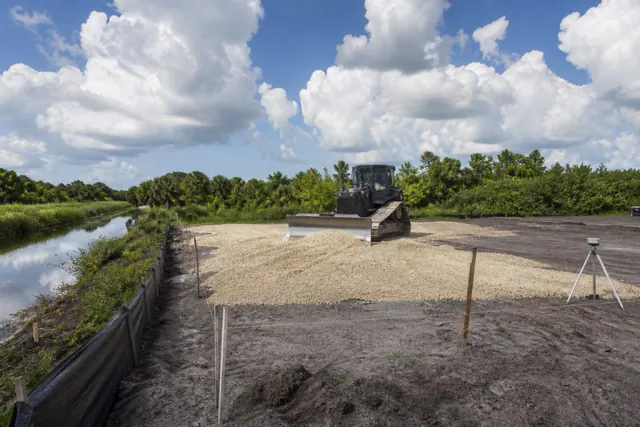
Horse Country Clearing puts Davie property owners in touch with a local land clearing contractor who handles grading & site prep on Davie and Broward County ground.
Once the vegetation is gone, it's the grading that determines whether the parcel actually functions. On ground as flat as Davie's, water has no opinion of its own — every inch of fall toward the swale has to be built deliberately, or the first wet-season storm will find the low spot you didn't know you had, usually against the barn wall. Site prep here is really drainage engineering carried out with a dozer and a laser.
The standard sequence on a ranchette project: strip and stockpile any usable topsoil, shape the subgrade so sheet flow moves away from structures, bring in shellrock fill for pads and drives, and compact in lifts to a surface that takes trucks without rutting. Building pads get set above the surrounding grade — cheap insurance in a county where summer storms routinely drop multi-inch totals in an afternoon.
Horse properties add their own specs. Paddock grades need to shed water without creating slick runs, arena bases want a dead-flat clay-free surface with engineered footing on top, and every graded line has to respect where the horses actually travel. It's the kind of nuance that separates an operator who has built equestrian ground from one who has only cut subdivisions.
Working with the water table, not against it
Central Broward's seasonal water table sits close under the surface — the USDA's Margate soil series description, mapped in this part of the county, classifies the ground as poorly drained sand over fractured limestone. Grading plans respect that reality: pads raised rather than dug, swales cut to carry sheet flow to the canal system, and no pretending an underground basement-style solution belongs in South Florida.
Those roadside and property-line swales aren't decorative — they're the capillaries of the regional flood-control network operated by the South Florida Water Management District. Good grading maintains their function; careless fill in a swale ships your drainage problem to a neighbor, and code enforcement knows it.
Shellrock: the local pad and driveway standard
The tan crushed limestone that South Floridians call shellrock is the default structural fill here for good reason: it's local, it compacts into a hard crust that sheds rain, and it bridges soft sandy spots that would swallow imported gravel. A typical Davie pad build runs 6 to 12 inches of compacted shellrock over shaped subgrade — thicker where horse trailers and delivery trucks will turn.
Climate drives the compaction schedule. Working shellrock at the right moisture makes the difference between a pad that sets up like concrete and one that ravels; crews here time lifts around rainfall using guidance as basic as the county's own Broward climate resources and the daily forecast. Dry-season grading is the premium slot — book it early.
Further reading
Worth knowing first
How much fall does a graded pad actually need?
Rules of thumb: pads crowned a few inches above surrounding grade, and finished ground sloping away from structures at roughly 1–2% for the first several feet. On dead-flat Davie parcels, that fall is created with fill, not found.
What's the difference between rough and finish grading?
Rough grading shapes the parcel's bones — cut, fill, and drainage direction — right after clearing. Finish grading is the fine pass before sod, footing, or concrete, where tolerances tighten from inches to fractions.
Can you grade around existing trees?
Yes, with discipline: no cut or fill inside the drip line of keeper oaks — even a few inches of soil over a root plate can smother a mature tree. Grades transition around protected root zones instead.
Do arenas and round pens need special grading?
They do — a laser-flat base graded for subsurface drainage, then footing material selected for the discipline ridden on it. It's the fussiest grading work on a horse property and worth doing once, properly.
Which months suit Davie grading work best?
The dry stretch from late fall into spring, while the water table sits low and storms are scarce. Wet-season grading happens, but it fights pumping subgrade and afternoon storms, and the schedule stretches accordingly.