 Horse Country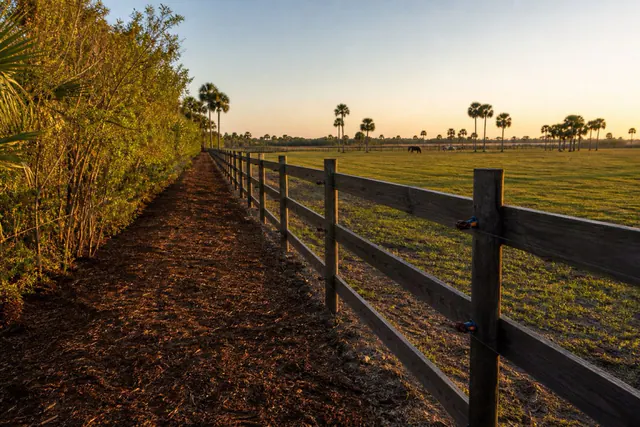
Horse Country Clearing puts Davie property owners in touch with a local land clearing contractor who handles fence line clearing on Davie and Broward County ground.
In a town built around board fences, the fence line is where overgrowth does its most expensive damage. Brazilian pepper and possum grape don't just hide a three-rail fence — they lever it apart, rot the rails they lean on, short out hot-wire, and turn the perimeter you're legally responsible for into a corridor you can't even inspect. Fence line clearing opens a clean machine-width strip along the run and gives the fence its job back.
Think of it as mulching at surgical tolerances rather than open-field grinding: a compact machine walks the line taking growth off the fence without taking the fence, then finishes with hand-cutting through the rails where trunks have grown between them. Freed lines usually need some honest triage afterward — a few rails replaced, posts re-set where root balls heaved them — and it's far cheaper done now than after another five years of loading.
There's a boundary-savvy angle too. Fences in Davie often sit on or near lot lines shared with neighbors, bridle paths, or canal easements, and the clearing strip may touch all three. An operator who works this town confirms the line, keeps spoil on your side, and leaves the trail beside your fence better than found — because around here, the neighbors ride past your work.
Horse-safe clearing practice along paddocks
Clearing against an occupied paddock is choreography: horses moved to the far field or stalled during machine hours, hot-wire de-energized and flagged, and no gap left open overnight. The mulched strip itself is checked before turnout — no spear-cut stubs at leg height, no wilted cherry or oleander trimmings within reach, nothing in the chip bed a hoof shouldn't find. Davie's equestrian identity is institutional — the town literally maintains a public equestrian trail network — and clearing crews that work here are expected to operate to that standard.
Where a fence line doubles as a trail edge, the finished corridor is left smooth enough to ride: no windrows against the rails, no chip berms that spook a green horse, sight lines open at the corners.
Keeping a cleared line clear
A fence line is a seed trap — birds perch on posts and plant pepper berries in a neat row beneath. That's why the follow-up matters as much as the clearing: an annual walk of the line pulling or spot-treating seedlings while they're finger-thin, guided by the control methods in UF/IFAS's Brazilian peppertree publication. Ten minutes a season versus another machine mobilization in five years — easy math.
Some owners go further and plant the cleared strip deliberately: bahia sod for mowability, or a spaced native hedge set back off the rails. Guidance on distinguishing the natives worth planting from the exotics worth pulling lives on the state wildlife agency's nonnative species pages.
Further reading
Worth knowing first
How is fence line clearing priced?
By the linear foot, adjusted for how bad the growth is and what's growing in the rails. A lightly brushed 300-foot run is quick; a pepper wall that has swallowed the fence takes machine time plus careful hand work, and the quote separates the two.
Can you clear the line without damaging the fence?
That's the craft. The machine takes everything up to a safe standoff, and growth inside the rails comes out by hand. Rails already rotted or sprung by trunks get flagged for you — clearing reveals fence condition, it doesn't cause it.
What about the neighbor's side of the fence?
Work stays on your side unless the neighbor signs on — and on shared lines it's often worth asking, since splitting one mobilization beats paying for two. Boundary questions get settled before the machine starts, not after.
Do horses have to leave the property during clearing?
Not the property — just the work zone. Far-paddock turnout or stalling during machine hours is the norm, coordinated day by day so the routine barely bends.
How often will the line need re-clearing?
With an annual seedling walk, possibly never at machine scale. Without one, pepper regrowth typically brings the mulcher back in four to six years.