 Horse Country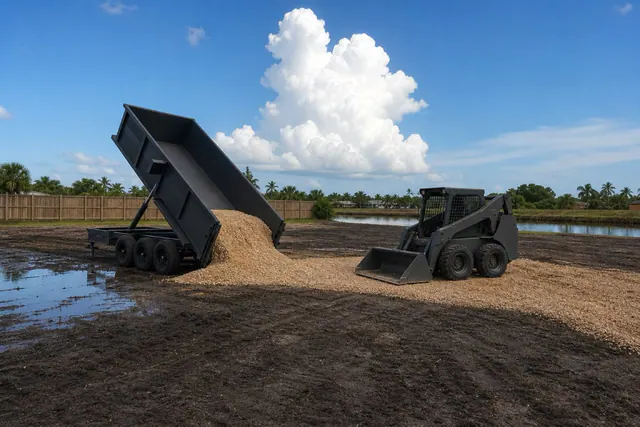
Horse Country Clearing puts Davie property owners in touch with a local land clearing contractor who handles fill dirt services on Davie and Broward County ground.
On land this flat, elevation is something you buy by the truckload. Fill service is the supply chain and the placement in one: clean fill or shellrock sourced from local pits, delivered in loads sized to your access, then spread and compacted to an actual grade plan rather than dumped in hopeful piles. It's how a Davie lot gets a building pad above the water table, how a chronically wet paddock corner becomes usable ground, and how a driveway stops being a canal in July.
Material selection is half the service. Clean sandy fill raises grades economically in bulk; shellrock caps and structural pads want crushed limestone that compacts tight; paddock repairs want material free of debris, glass, and construction junk — 'clean' is a specification, not a compliment. Loads that arrive on a horse property carry an extra duty of care, because whatever is in that pile eventually meets a hoof.
The other half of the service is how the material goes down. Fill dumped loose goes on subsiding season after season, while material laid in thin lifts under a roller or plate hits its density within days and stays where the grade plan put it. And every fill job on this ground starts with a drainage question — raising your corner must not drown the neighbor's, so the water's exit route gets designed before the first truck tips.
Why so much of Davie needs fill at all
The county's native ground is low, flat, and seasonally saturated — soil surveys like the USDA's Margate series description classify large areas as poorly drained, with the water table near the surface in the wet months. Building on it has always meant building up. That's also why fill placement is regulated in flood-prone areas: grade changes interact with the flood elevations and the drainage network under the regional stewardship of the South Florida Water Management District — larger projects need engineered plans, not just enthusiasm.
For routine residential work — a low fence corner, a pad for a shed, driveway repair — the process is simpler, but the principle holds: know where the displaced water goes.
Ordering fill like someone who's done it before
Quantities confuse everyone once: a standard dump truck hauls somewhere near 15 to 18 cubic yards, and raising just a quarter acre by one foot swallows around 400 yards — twenty-plus truckloads. Getting the math right before ordering beats discovering it in your driveway. Timing matters too: hauling and compacting in the dry months, tracked via the county's climate resources and the daily forecast, produces better density and fewer rutted lawns than fighting the summer soak.
Access decides the equipment: full-size trucks need swing room and firm ground, while tight ranchette gates often mean smaller trailers and a skid-steer relay — more trips, but no crushed septic tank and no gate posts sacrificed to a mirror.
Further reading
Worth knowing first
Fill dirt, topsoil, shellrock — which one does my project want?
Fill dirt is bulk structural material for raising grade — sandy, cheap, compactable. Topsoil is the organic planting layer, reserved for spots that will grow something. Shellrock is crushed limestone for surfaces and pads. Most projects use fill for volume and finish with one of the other two.
How many truckloads will my project need?
Multiply the area by the depth of the raise, turn the cubic feet into yards, and tack on a compaction cushion of a tenth to a fifth. A 50 × 50 ft area raised 6 inches is roughly 46 yards before compaction — call it three big loads. The quote does this math against a real measurement.
Can trucks reach the back of my property?
That's the first site question. Firm dry ground and a 12-foot corridor, yes; wet season or tight gates usually mean staging loads up front and relaying with a skid-steer. It changes cost, so it's settled during the walk, not on delivery day.
Will new fill settle?
Compacted-in-lifts fill barely moves. Loose-dumped fill can settle noticeably for a couple of years — fine for a rough berm, disqualifying under anything with a slab, post, or pipe.
Is a permit needed to bring in fill?
Small residential top-ups are generally routine; larger grade changes, work near canals and swales, and anything in a mapped flood zone bring rules into play. The contractor placing it will tell you where your project sits — before trucks roll.