 Horse Country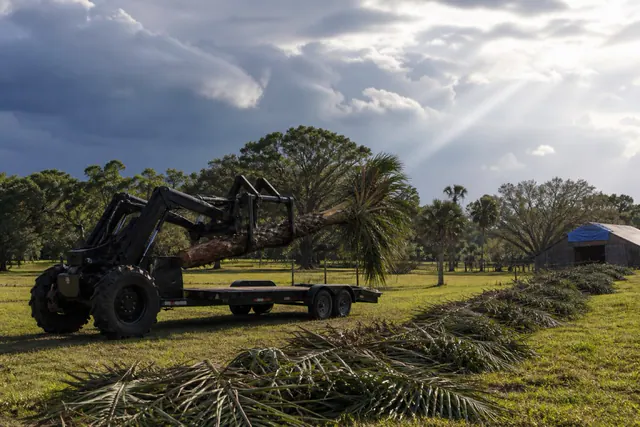
Horse Country Clearing puts Davie property owners in touch with a local land clearing contractor who handles storm debris cleanup on Davie and Broward County ground.
Every hurricane season, some corner of Broward finds out what its trees weigh. When a storm drops a canopy across a Davie acreage, the aftermath is a specific kind of mess: whole oaks down across fences, palms snapped mid-trunk, half-fallen trees hung up in their neighbors, and a paddock's worth of frond and limb litter that a rake will never move. Storm cleanup is the machine response — grapple loaders, saws, and trailers working through it in days instead of the months a hand crew would need.
Order of operations is safety logic. Access first: the driveway and gate corridor opened so vehicles, feed deliveries, and the vet can get in. Hazards second: hung 'widow-maker' limbs and root-plate leaners brought down under control, lines and fences unpinned. Then volume: material bucked, staged, and either ground on site or hauled, with the paddocks walked for the small debris that punctures hooves and mower tires.
On horse properties, cleanup doubles as damage triage. Freed fence runs are checked for stock-tightness before turnout, gates rehung, and any arena or shelter shade structure inspected while the equipment is already on site. The point is compressing the interval between storm passage and a property that works again.
Before the season: the cheaper half of storm work
The Atlantic season occupies the calendar from the first of June to the end of November — follow it at the National Hurricane Center, and the best storm-debris work happens before there is any: pre-season removal of the compromised trees that always fail first. Dead pines, over-extended ficus limbs over barns, and top-heavy melaleuca on the fence line are the predictable casualties — taking them out in May is scheduled work at normal prices; taking them off a collapsed fence in September is emergency work in a county-wide equipment shortage.
The federal preparedness guidance at weather.gov's hurricane safety pages makes the same point for structures; it applies double to trees, which don't get shutters.
After landfall: how cleanup actually proceeds
Expect triage pricing and honest queues. After a direct hit, every operator in the county is oversubscribed, so the queue runs on danger, not on who called first: a trunk across a roof or a blocked gate outranks a downed fence run, and cosmetic raking waits at the back of the line. Local operators also coordinate with municipal debris programs — residential curbside rules differ from what private crews can haul — and the NWS Miami office stays the source of record for the follow-on weather that complicates wet cleanups.
One warning earned by every storm: be wary of out-of-town crews knocking doors with chainsaws and round numbers. The value of reaching an operator through a local channel is knowing the same business will still be in Broward when the follow-up question comes.
Further reading
Worth knowing first
What kind of wait am I looking at once a storm has passed?
Depends on the hit. After a brush from a weak storm, often same-week; after a direct major hurricane, hazard jobs come first and the queue is real. Calling early with clear photos gets you sequenced accurately.
Is a leaning tree with a lifted root plate salvageable?
Small trees sometimes stand back up with staking; large leaners with heaved root plates are permanent hazards and come out. Anything leaning over a paddock, path, or structure gets priority.
Who handles debris on the fence line I share with a neighbor?
Practically, whoever's tree it was often matters less than getting it done — many neighbors split the cost of one crew doing the whole line. Insurance questions about the fence itself go to your carriers; the cleanup itself doesn't need to wait.
Can storm debris be burned on my property?
Open burning in residential Davie runs into county and state fire rules and is a poor idea near barns regardless — grinding and hauling are the standard. Post-storm, curbside municipal pickup handles bounded quantities from occupied homes.
Should damaged trees be removed or just trimmed?
Broken leaders and split crotches usually doom a tree slowly — removal now beats a second failure later. Cleanly stripped canopy on a healthy oak, by contrast, often regrows. An honest crew tells you which is which, tree by tree.