 Horse Country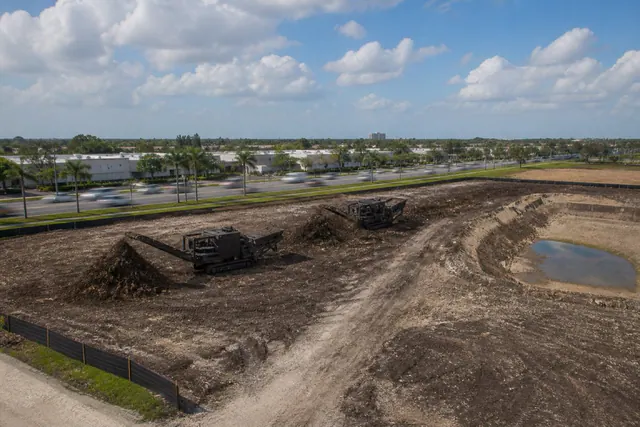
Horse Country Clearing puts Davie property owners in touch with a local land clearing contractor who handles commercial site clearing on Davie and Broward County ground.
Commercial clearing is the industrial cousin of everything else on this site: bigger machines, tighter paper, and a schedule that belongs to someone else's critical path. Whether the parcel is a retail pad on a Davie arterial, a self-storage site, or an equestrian commercial venue, the deliverable is the same — vegetation off, root mats grubbed, debris processed, and the site left at rough grade with erosion controls standing, ready for the earthwork contractor.
In Broward, the paperwork is a genuine phase of the work. Commercial land development triggers county-level environmental screening — tree surveys and mitigation, gopher tortoise checks where scrub exists, and stormwater pollution prevention with silt fence and stabilized construction entrances inspected in the field. A clearing contractor fluent in that sequence keeps the notice-to-proceed clean; one who isn't becomes the reason the project log has a red bar in it.
Production is where scale pays. Multi-acre sites run mulchers and excavators in tandem — grinders processing windrows while extraction works ahead of them — with trucking cycled so the site never chokes on its own debris. On corridor-adjacent parcels, maintenance-of-traffic and dust control are part of daily operations, because the arterial out front doesn't stop being six lanes just because trees are coming down behind the silt fence.
The environmental file that precedes the machines
Broward County's development rules put natural-resource screening early in the sequence — tree preservation and licensing questions route through the county's environmental programs, and projects touching wetlands or surface-water management interact with the South Florida Water Management District permit framework. Invasive exotics cut the other way: pepper and melaleuca on a development parcel are typically required removals, and clean documentation of what came out keeps mitigation accounting straightforward.
The clearing contractor's role in that file is disciplined execution: barricades where the tree survey says, controls installed before disturbance, and no machine crossing a line an inspector will later ask about.
Scheduling around a South Florida sky
Commercial schedules meet Broward weather with open eyes. The wet season loads afternoons with storm cells — the NWS Miami office is the daily reference — and hurricane season overlays June through November with the tail risk the National Hurricane Center tracks. Competent site work builds both into the plan: erosion controls maintained storm-ready rather than rebuilt after, debris windrows processed promptly so they can't become airborne inventory, and dry-season slots protected for the water-sensitive phases.
The payoff of clearing done this way is boring and valuable: an earthwork contractor who mobilizes onto a stable, documented, surprise-free site — which is what keeps the next trade's schedule intact too.
Further reading
Worth knowing first
What information do you need to quote a commercial clearing?
Parcel ID or survey, the site plan or at least the disturbance limits, any tree survey and environmental conditions already in hand, and the target window. With those, a walk and a unit-priced proposal follow quickly — clearing, grubbing, hauling, and controls as separate lines.
Can you clear in phases to match our financing or permits?
Yes — phased limits with maintained controls between phases are routine, and mulch-in-place on future phases keeps them stable and cheap to hold.
Who handles the tree survey and mitigation?
The survey comes from your consultant; the clearing crew executes to it — protective barricades, tagged saves, and documented removals. Mitigation strategy stays with the owner's team, with field data supplied from the ground.
How fast does multi-acre clearing move?
With processing on site, a production crew turns roughly an acre or more a day in typical Broward growth — dense pepper stands and heavy grubbing slow that, and hauling distance sets the ceiling as often as machine speed.
Is the ground truly ready for earthwork when you leave?
The handoff spec is agreed up front: grubbed to depth within building and pavement limits, organics off the structural areas, rough grade to tolerance, controls standing and stabilized. Documented deviations beat discovered ones.