 Horse Country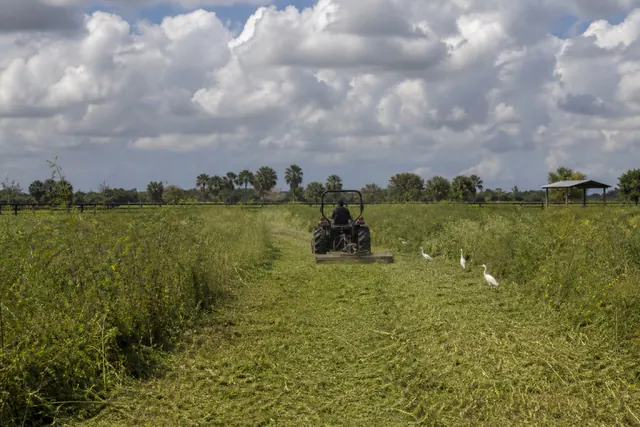
Horse Country Clearing puts Davie property owners in touch with a local land clearing contractor who handles pasture reclamation on Davie and Broward County ground.
A Davie paddock that sits empty for a couple of years doesn't stay a paddock — dog fennel and pepper seedlings take the middle, vines take the fences, and what was grazing becomes browse. Pasture reclamation reverses the slide in one coordinated push: woody invaders out by the roots, herbaceous overgrowth mowed to grade, the ground smoothed where hooves and machines have pocked it, and the forage given room to reestablish.
The order of work is agronomic, not cosmetic. Woody stems come out first because every month they stand, their shade thins the grass that's supposed to win the ground back. Then the mowing passes step down progressively, because scalping tall fennel flat in one cut dumps a hay-like mat that smothers regrowth. Finally the surface work: filling the holes and ruts that turn a canter into a vet bill, and re-cutting the drainage lines that keep hooves out of standing water.
What the reclaimed field grows next is the owner's call. Some Davie paddocks go back to maintained bahia turf, others get managed as sacrifice lots with hay feeding, and larger parcels sometimes split the difference — grazed front field, mowed-once-a-year back field kept as habitat edge. The clearing plan bends to the horsekeeping plan, not the other way around.
Plants a reclaimed paddock must not keep
Beyond the obvious exotics, reclamation is a toxic-plant sweep. Creeping indigo — a low, pink-flowered exotic implicated in serious neurologic disease in horses — has turned up across South Florida pastures, and rosary pea, lantana, and wild cherry all belong on the pull list. The machine work removes the mass; the walk-through afterward, informed by resources like the FWC's invasive plant program, catches the low growers that a mower hides. Any regionally coordinated species — the kind tracked by the Florida Invasive Species Partnership — gets flagged rather than quietly mowed over.
Horses make the stakes personal: a bored or hungry horse samples what a well-fed one ignores, so the standard is clearance you'd trust with your own animals, not a tidy-looking field.
Rebuilding grass on Broward sand
Central Broward pasture soil is sandy, low in organic matter, and wet-footed in summer — the USDA's Margate series description spells out the poorly drained profile much of the area sits on. Bahiagrass tolerates it better than most forages, which is why it dominates local paddocks: it takes traffic, shrugs off drought once established, and recovers from grazing. Reclamation timed to the early wet season gives new seed the free irrigation.
The first year after reclamation decides the next decade. Light or rotated grazing while the stand thickens, a mowing schedule that never lets fennel reach knee height, and a fall walk for pepper seedlings — that maintenance loop keeps the field a mowing job forever, instead of a mulching job again in five years.
Further reading
Worth knowing first
How much does it cost to reclaim an overgrown paddock?
A lightly overgrown acre — tall herbaceous growth, scattered woody stems — is a modest machine day. Add established pepper domes, surface repair, and hauling and it scales toward light lot-clearing money. The site walk sorts your field into the right bucket, free.
How soon can horses graze the reclaimed field?
Once two things are true: the surface has been swept of hazardous debris and cut stubs, and any treated or suspect plants are cleared per label and common sense. For newly seeded ground, grazing waits until the stand can take a hoof — typically a few months.
Can reclamation happen with horses still on the property?
Yes — it's the normal case in Davie. Work proceeds field by field with stock rotated away from the active zone, and perimeter integrity is verified before every turnout.
Mow it or mulch it — which does my field need?
Stems you can bend with your boot are mowing; stems that need loppers are mulching; anything with a root ball that would re-lever a fence is extraction. Most neglected paddocks need a mix, which is why the job is quoted as reclamation rather than as one machine's work.
What keeps the fennel from coming right back?
Mowing frequency. Dog fennel loses to any grass that gets mowed regularly, because mowing exhausts its tall-growth strategy. Let the field go shaggy for a season, though, and it will volunteer to take over again.